Summary
This changelog records material edits to the public draft and policy updates between Nov 2025 and Jan 2026.
Mechanism
Each release increments the version and date. Breaking changes are noted explicitly.
Entries
| Date | Version | Notes |
|---|---|---|
| 2025-11-15 | v0.1.0 | Initial public outline and scope definition. |
| 2025-12-10 | v0.1.1 | Added token utility and marketplace mechanics. |
| 2026-01-17 | v0.1.2 | Expanded governance, risks, and parameter registry. |
Parameters
| name | purpose | default | bounds | governance | cadence | transparency |
|---|---|---|---|---|---|---|
| changelog_cadence | How often updates are published | Monthly | TBD | Phase 1/2 | Monthly | Public notice + log |
Rationale
A clear change history improves stakeholder trust and auditability.
Risks & mitigations
- Stale updates → set a regular publication cadence.
- Missing edits → require internal review before publishing.
Open questions
- TODO: Confirm update cadence after private launch.
Summary
This whitepaper describes the platform and token mechanics at a high level. It is not an offer or solicitation.
Mechanism
Access and participation may be restricted by jurisdictional policy. Token utility is framed as access and resource allocation.
Parameters
| name | purpose | default | bounds | governance | cadence | transparency |
|---|---|---|---|---|---|---|
| jurisdiction_policy | Allowed regions for access | TBD | TBD | Phase 1/2 | As needed | Public notice |
Rationale
Clear disclaimers protect users and reduce misinterpretation of utility tokens.
Risks & mitigations
- Misinterpretation as investment → plain‑language disclosures.
- Regulatory changes → update access policies.
Open questions
- TODO: Define jurisdiction list before public launch.
Summary
The platform combines research tooling, execution support, and a plugin marketplace. The token aligns incentives without being required for basic access.
Mechanism
Users can access public resources freely while premium features require credits or tokens. Contributors earn rewards based on verified impact.
Parameters
| name | purpose | default | bounds | governance | cadence | transparency |
|---|---|---|---|---|---|---|
| access_policy | Defines public vs premium access | TBD | TBD | Phase 1 | Quarterly | Public notice |
Rationale
A hybrid access model broadens adoption while preserving value for advanced users.
Risks & mitigations
- Low premium conversion → iterate pricing and feature mix.
Open questions
- TODO: Finalize public vs premium feature list.
Summary
The platform targets quant researchers, systematic traders, and infrastructure builders who value reproducibility and verified performance.
Mechanism
Documentation, templates, and tooling standardize how strategies are developed, shared, and reviewed.
Parameters
| name | purpose | default | bounds | governance | cadence | transparency |
|---|---|---|---|---|---|---|
| content_standards | Minimum submission metadata | TBD | TBD | Phase 1 | Quarterly | Public spec |
Rationale
Clear audience and standards reduce noise and improve contribution quality.
Risks & mitigations
- Scope creep → maintain a stable core module roadmap.
Open questions
- TODO: Publish initial submission standards.
Summary
Existing communities suffer from unverifiable claims, weak incentives, and limited reproducibility.
Mechanism
A shared reputation system and usage‑based metrics address coordination and quality challenges.
Parameters
| name | purpose | default | bounds | governance | cadence | transparency |
|---|---|---|---|---|---|---|
| reputation_weight | Influence of reputation on rewards | TBD | 0–1 | Phase 2 | Quarterly | Public notice |
Rationale
Without verified usage, rewards can be gamed and trust decays.
Risks & mitigations
- Reputation capture → require review diversity and caps.
Open questions
- TODO: Define baseline reviewer reputation model.
Summary
Resilient LAB 505 merges research workflows with execution tooling and a marketplace built on verifiable usage.
Mechanism
Verified usage receipts and reviewer scores determine rewards and ranking.
Parameters
| name | purpose | default | bounds | governance | cadence | transparency |
|---|---|---|---|---|---|---|
| receipt_weight | Weight of usage receipts | TBD | 0–1 | Phase 2 | Quarterly | Public notice |
Rationale
Utility‑driven incentives align creators and users without requiring speculative behavior.
Risks & mitigations
- Insufficient data quality → enforce reproducibility standards.
Open questions
- TODO: Publish receipt format and privacy policy.
Summary
The architecture includes research tooling, execution tooling, marketplace, and reputation layers.
Mechanism
Data flows from usage receipts and reviews into the reputation engine, which influences rewards.
Parameters
| name | purpose | default | bounds | governance | cadence | transparency |
|---|---|---|---|---|---|---|
| receipt_retention_days | Retention of usage receipts | TBD | 30–365 | Phase 2 | Annual | Public policy |
Rationale
Clear modular boundaries simplify audits, scalability, and security.
Risks & mitigations
- Integration complexity → keep interfaces narrow and versioned.
Open questions
- TODO: Publish a public architecture diagram.
Summary
The token allocates scarce platform resources and aligns incentives. It is not a profit‑sharing instrument.
Mechanism
Token usage is tied to premium actions, marketplace purchases, and staking roles.
Parameters
| name | purpose | default | bounds | governance | cadence | transparency |
|---|---|---|---|---|---|---|
| token_standard | Token standard (e.g., ERC‑20) | TBD | N/A | Phase 1 | One‑time | Public spec |
Rationale
Clear non‑goals reduce misinterpretation and compliance risk.
Risks & mitigations
- Misaligned incentives → maintain utility‑first policy.
Open questions
- TODO: Confirm chain and token standard.
Summary
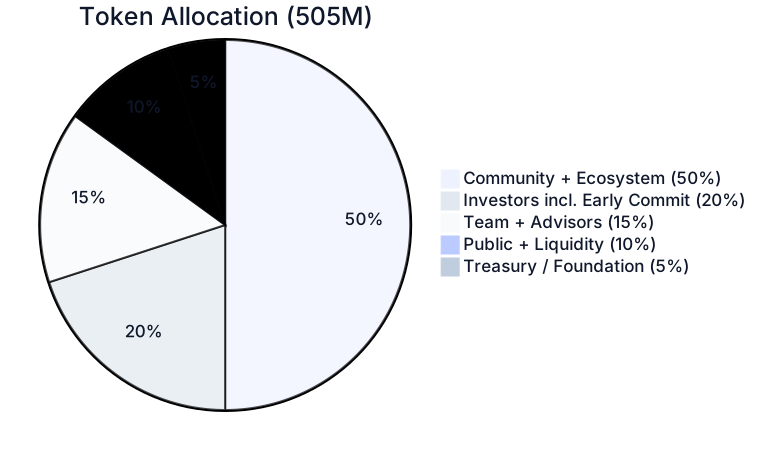
Fixed supply of 505,000,000 tokens with a stable allocation profile based on median references from successful L2 and GameFi projects. Team allocation is capped at 15% and the target TGE float is 10–15%.
Allocation (detailed draft)
| bucket | % | tokens | sub‑bucket | sub‑% | tokens |
|---|---|---|---|---|---|
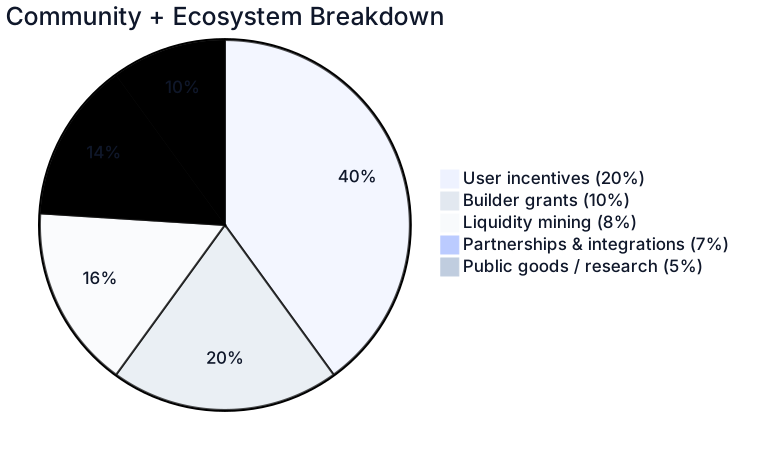
| Community + Ecosystem | 50% | 252,500,000 | User incentives | 20% | 101,000,000 |
| Builder grants | 10% | 50,500,000 | |||
| Liquidity mining (non‑LP) | 8% | 40,400,000 | |||
| Partnerships & integrations | 7% | 35,350,000 | |||
| Public goods / research | 5% | 25,250,000 | |||
| Team + Advisors | 15% | 75,750,000 | Core team | 12% | 60,600,000 |
| Advisors | 3% | 15,150,000 | |||
| Investors (incl. Early Commit) | 20% | 101,000,000 | Early Commit | 0.5% | 2,525,000 |
| Private / Strategic | 19.5% | 98,475,000 | |||
| Public Sale + Liquidity | 10% | 50,500,000 | Public sale | 6% | 30,300,000 |
| Liquidity / MM | 4% | 20,200,000 | |||
| Treasury / Foundation | 5% | 25,250,000 | Treasury reserve | 3% | 15,150,000 |
| Foundation ops | 2% | 10,100,000 |
TGE float composition (target 10–15%)
| source | indicative % of total supply | notes |
|---|---|---|
| Public sale | 5–6% | 50% at TGE + 3‑month linear |
| Liquidity / MM | 3–4% | LP lock: 365 days with on‑chain proof |
| Ecosystem bootstrap | 1–2% | Small initial incentives |
| Early Commit | 0.05% | 10% of Early Commit unlocked at TGE |
Vesting & unlock schedule (draft)
Team + Advisors (15%)
- Cliff: 12 months
- Vesting: 36–48 months linear, monthly
- TGE unlock: 0%
Private / Strategic (19.5%)
- Cliff: 12 months
- Vesting: 24–36 months linear, monthly
- TGE unlock: 5–10% (finalized per round)
Early Commit (0.5%)
- TGE unlock: 10%
- Vesting: 6 months linear
- Per‑wallet cap: 0.2 BNB
Public Sale (6%)
- TGE unlock: 50%
- Remainder: 3 months linear
Liquidity / MM (4%)
- Locked LP: 365 days, public proof of lock
- Release: governed by market‑making KPI and governance vote
Community + Ecosystem (50%)
- Programmatic release over 36–48 months
- Quarterly budgets, transparent reporting
Treasury / Foundation (5%)
- Reserve for governance, audits, operations
- Release by proposal and public reporting
Supply and FDV references
FDV price reference using total supply:
- $20M FDV → ~$0.0396
- $50M FDV → ~$0.0990
- $100M FDV → ~$0.1980
Parameters
| name | purpose | default | bounds | governance | cadence | transparency |
|---|---|---|---|---|---|---|
| total_supply | Total fixed supply | 505,000,000 | Fixed | Phase 1 | One‑time | Public notice |
| team_cap | Team + advisors cap | 15% | 10–20% | Phase 1 | One‑time | Public notice |
| tge_float_target | TGE circulating target | 10–15% | 8–20% | Phase 1 | One‑time | Public notice |
| early_commitment_share | Early commit allocation | 0.5% | 0–2% | Phase 1 | One‑time | Public notice |
| vesting_team_months | Team vesting | 36–48 | 24–60 | Phase 1 | Monthly | Public schedule |
| vesting_investor_months | Investor vesting | 24–36 | 12–48 | Phase 1 | Monthly | Public schedule |
| lp_lock_days | LP lock | 180–365 | 90–1,095 | Phase 1 | One‑time | Public proof |
Rationale
Stable allocations prioritize long‑term ecosystem growth while capping team dilution.
Risks & mitigations
- Allocation skepticism → publish full vesting schedules and on‑chain lock proofs.
- Short‑term sell pressure → keep TGE float within target range and use staged releases.
Open questions
- Finalize public sale unlock (50–100%).
Summary
Token utility covers premium access, marketplace payments, and staking‑based roles.
Mechanism
Credits are granted via subscriptions; tokens are consumed for premium actions and staking locks.
Parameters
| name | purpose | default | bounds | governance | cadence | transparency |
|---|---|---|---|---|---|---|
| credit_per_plan | Monthly credits by plan | TBD | TBD | Phase 1 | Quarterly | Public notice |
| premium_action_cost | Cost per premium action | TBD | TBD | Phase 2 | Quarterly | Public notice |
| creator_stake_min | Listing stake minimum | TBD | TBD | Phase 2 | Quarterly | Public notice |
Rationale
Utility‑first design supports sustainable usage and reduces speculation.
Risks & mitigations
- Confusing pricing → publish a clear pricing table.
Open questions
- TODO: Define credit rollover and expiry.
Summary
Rewards are based on verified usage, retention, and reputation‑weighted ratings.
Mechanism
Usage receipts and reviewer scores feed into periodic reward epochs.
Parameters
| name | purpose | default | bounds | governance | cadence | transparency |
|---|---|---|---|---|---|---|
| reward_epoch_days | Reward cycle length | TBD | 7–90 | Phase 2 | Quarterly | Public notice |
| reward_pool_release | Monthly release rate | TBD | TBD | Phase 2 | Quarterly | Public report |
Rationale
Quantifying impact reduces gaming and improves contributor quality.
Risks & mitigations
- Sybil attacks → staking and unique user caps.
Open questions
- TODO: Define receipt verification method.
Summary
Governance starts with product priorities and expands to treasury ranges and protocol changes.
Mechanism
Proposal lifecycle: draft → discussion → vote → timelock → execution, with emergency controls.
Parameters
| name | purpose | default | bounds | governance | cadence | transparency |
|---|---|---|---|---|---|---|
| quorum_pct | Voting quorum | TBD | 5–25% | Phase 2 | Quarterly | Public notice |
| timelock_days | Execution delay | TBD | 1–14 | Phase 2 | Quarterly | Public notice |
Rationale
Phased governance limits risk while the product matures.
Risks & mitigations
- Low participation → delegation support and clear governance education.
Open questions
- TODO: Select final voting model (token‑weighted vs delegated).
Summary
Security includes contract audits, bug bounties, and operational safeguards.
Mechanism
Critical flows are subject to manual review, rate limits, and public incident reporting.
Parameters
| name | purpose | default | bounds | governance | cadence | transparency |
|---|---|---|---|---|---|---|
| audit_requirement | Audit before public launch | Required | N/A | Phase 1 | One‑time | Public report |
| bounty_budget | Annual bug bounty budget | TBD | TBD | Phase 2 | Annual | Public report |
Rationale
Operational transparency increases trust and reduces systemic risk.
Risks & mitigations
- Audit gaps → staged releases and time‑boxed upgrades.
Open questions
- TODO: Define bounty scope.
Summary
Access may be restricted by jurisdiction. KYC/AML may apply to certain tiers.
Mechanism
Policies are defined and updated with public notice and changelog entries.
Parameters
| name | purpose | default | bounds | governance | cadence | transparency |
|---|---|---|---|---|---|---|
| kyc_threshold | Tier requiring KYC | TBD | TBD | Phase 2 | As needed | Public notice |
Rationale
A compliance posture reduces legal risk and supports sustainable growth.
Risks & mitigations
- Policy changes → clear advance notice.
Open questions
- TODO: Define KYC thresholds for private allocation tiers.
Summary
This section records key risks and mitigations for market, technical, and operational domains.
Mechanism
Risks are reviewed periodically and updated with mitigation status.
Parameters
| name | purpose | default | bounds | governance | cadence | transparency |
|---|---|---|---|---|---|---|
| risk_review_cadence | Review frequency | Quarterly | Monthly–Quarterly | Phase 2 | Quarterly | Public log |
Rationale
A risk register improves accountability and prioritization.
Risks & mitigations
| Risk | Category | Severity | Likelihood | Mitigation | Residual risk |
|---|---|---|---|---|---|
| Market regime shift | Market | High | Med | Forward‑testing and disclosure | Med |
| Backtest overfitting | Technical | Med | Med | Reproducibility checks | Low–Med |
| Smart contract bug | Smart Contract | High | Low–Med | Audits + staged releases | Med |
| Malicious plugin supply chain | Operational | High | Med | Review + sandboxing + slashing | Med |
| Data exfiltration | Operational | Med | Low–Med | Sandbox + permissioning | Low–Med |
| Collusion in reviews | Governance | Med | Low–Med | Reputation weighting + caps | Low–Med |
Open questions
- TODO: Publish annual risk review process.
Summary
Roadmap milestones align with product readiness and community validation.
Mechanism
Milestones unlock governance scope and resource expansion.
Parameters
| name | purpose | default | bounds | governance | cadence | transparency |
|---|---|---|---|---|---|---|
| expansion_threshold | Usage needed for expansion | TBD | TBD | Phase 2 | Quarterly | Public notice |
Rationale
Milestone gating reduces risk and ensures stable scaling.
Risks & mitigations
- Delayed milestones → publish progress updates.
Open questions
- TODO: Define quantitative thresholds for chain expansion.
Summary
This registry tracks adjustable parameters, governance phase, and transparency rules.
Mechanism
Parameter changes require public notice and changelog entries.
Parameters
| name | purpose | default | bounds | who_can_change | cadence | transparency |
|---|---|---|---|---|---|---|
| credit_per_plan | Monthly credits by plan | TBD | TBD | Phase 1/2 | Quarterly | Public notice |
| premium_action_cost | Cost per premium action | TBD | TBD | Phase 2 | Quarterly | Public notice |
| api_rate_limit_tier | Rate limit per tier | TBD | TBD | Phase 1 | Quarterly | Public notice |
| creator_stake_min | Listing stake minimum | TBD | TBD | Phase 2 | Quarterly | Public notice |
| reviewer_stake_min | Reviewer stake minimum | TBD | TBD | Phase 2 | Quarterly | Public notice |
| proposal_bond | Anti‑spam bond | TBD | TBD | Phase 2 | Quarterly | Public notice |
| listing_bond | Listing bond | TBD | TBD | Phase 2 | Quarterly | Public notice |
| reward_epoch_days | Reward cycle length | TBD | 7–90 | Phase 2 | Quarterly | Public notice |
| reward_pool_release | Reward release rate | TBD | TBD | Phase 2 | Quarterly | Public report |
| quorum_pct | Governance quorum | TBD | 5–25% | Phase 2 | Quarterly | Public notice |
| timelock_days | Governance timelock | TBD | 1–14 | Phase 2 | Quarterly | Public notice |
| slashing_threshold | Slashing trigger | TBD | TBD | Phase 2 | Quarterly | Public notice |
| treasury_budget_cap | Treasury spending cap | TBD | TBD | Phase 2 | Quarterly | Public report |
| liquidity_lock_days | Liquidity lock | TBD | 180–1095 | Phase 1 | One‑time | Public proof |
Rationale
A single registry reduces ambiguity and helps governance remain transparent.
Risks & mitigations
- Parameter drift → enforce notice periods.
Open questions
- TODO: Finalize parameter bounds.
Summary
The following diagrams visualize token flows, governance lifecycle, and token allocation/vesting.
Mechanism
Mermaid diagrams reflect the mechanics described in this whitepaper.
Parameters
| name | purpose | default | bounds | governance | cadence | transparency |
|---|---|---|---|---|---|---|
| diagram_refresh | Update cadence | Quarterly | Monthly–Quarterly | Phase 1 | Quarterly | Public notice |
Rationale
Diagrams improve clarity and reduce misinterpretation.
Risks & mitigations
- Diagram drift → update alongside changelog.
Open questions
- TODO: Add detailed data‑flow diagram after beta.
Token allocation (draft)
Community + ecosystem breakdown (draft)
Vesting overview (draft)


